A wide range of advanced non-nuclear submarines can provide excellent asymmetric defence within 4,000 km of Australia if distributed to ports around the country.
Many non-nuclear boats can be bought for the price of ONE Virginia class submarine. Non-nuclear boats are much cheaper to operate.
Japanese Taigei submarines are recommended. Naval Group, TKMS and Hanwha / Hyundai have good options as well.
Available Non-Nuclear Submarines
| Non-nuclear boats | Manufacturer | Built | Submerged endurance |
|---|---|---|---|
| Taigei | Mitsubishi / Kawasaki | 6 | 4 weeks with Li-S batteries. |
| Scorpène Evolved | Naval Group | 0 | 80 days with lithium-ion batteries. |
| Scorpène | Naval Group | 13 | 3 weeks if FC2G fuel cells used (diesel & O2). |
| Orka class | Naval Group | 0 | Several days at top speed…probably 3+ weeks at low speed. Li batteries. |
| Type 212CD | TKMS | 0 | 40 days with PEM fuel cells + Li batteries. (2 being built) |
| Type218SG | TKMS | 4 | 4-6 weeks with fuel cell & Li batteries |
| Blekinge A26 | Saab | 0 | 3 weeks with Stirling AIP. |
| KS-III | Hanwha / Hyundai | 3 | 3+ weeks with Li-S batteries. VLS for land attack – which we don’t need. |
| S-80+ | Navantia | 2 | 3+ weeks with bioethanol-powered fuel cells. 16 years to build. |
Uncrewed submarines & smart mines
Unlike nuclear submarines, we could easily have hundreds of these that could swarm hostile naval shipping at a comparatively low cost.
| Name | Notes |
|---|---|
| Ghost shark XL-UUV | Currently in the RAN, “dozens” planned |
| SpearTooth Large UUV | Australian company |
| Smart mines | In development for the ADF now |
The mission – anti-ship only
Threaten hostile ships and submarines within 3,000km of Australia from under the sea with torpedoes and mines. (Missiles launched from aircraft and trucks can threaten ships from above.)
These submarines should be used for an anti-ship role only and not be equipped with land-strike missiles or to secretly land special forces. Adding these additional capabilities would reduce their anti-ship effectiveness and undermine relations with our neighbours.
Nuclear vs. Taigei: Cost
The fourth Taigei Class submarine cost $US 470 million. Virginia SSN cost about $US 4,500 million ($A7 billion) each.
| 3 x Virginia SSN 5 x AUKUS SSN 6 x Collins Class SSK | 14 x Taigei SSK |
| Item | $B | Item | $B |
|---|---|---|---|
| Collins Repairs | 11 | 14 x Taigei non-nuclear submarines | 14 |
| Virginia and AUKUS | 368 | ||
| SSN Pens | Included | SSK Pens** | 4 |
| TOTAL | 379 | 18 |
(* Nuclear subs can operate till the food runs out. Approximate cost in A$ rounded up to nearest billion. Sustainment cost far less for diesel-electric boats. ** Non-nuclear submarine pens should cost less.)
Nuclear vs. Taigei: Weapons at Sea
| 3 x Virginia SSN 6 x Collins Class SSK | 9 x Taigei SSK |
| Nuclear + Collins LOTE | Weapons | Total | Taigei | Weapons | Total |
|---|---|---|---|---|---|
| Collins SSK | 22 | 132 | Taigei non-nuclear submarines | 30 | 300 |
| Virginia Block IV SSN | 37 (Includes 12 in VLS) | 111 | |||
| TOTAL | 243 | 270 |
- One class to maintain instead of three (Collins, Virginia, AUKUS)
- AUKUS class vs. alternative number of “Taigei-successor submarines” not included as cost and capabilities are speculative.
Submerged endurance
Diesel-electric submarines can snorkel near the surface to recharge their batteries but doing this daily increases the risk of detection.
Nuclear submarines can stay submerged until the food runs out but are much larger so could be detected using other techniques.
| Submarine | Submerged endurance |
|---|---|
| Collins SSK after refurbishment | 1 day with lead-acid batteries |
| Taigei SSK | ~30 days with lithium batteries |
| Virginia SSN | ~80 days until the food runs out |
Japanese Sōryū & Taigei submarines
“Japan’s new Taigei class … provide the Japan Maritime Self-Defense Force with some of the most advanced underwater performance of any submarine force in the world.” (US Naval Institute)
Eight Japanese submarines have been built with Lithium-Sulphur batteries to date with each one taking 2.5 years to complete. Lithium-Sulphur batteries appear to be less complex to operate and support than fuel-cell systems. (2 Sōryū + 6 Taigei)
Theoretically multiple boats could be assembled in parallel in various electorates around Australia using imported components. (This would be instead of the 11 Mogami-class frigates Australia is buying from Japan.)
(Note that Tony Abbott wanted to buy Sōryū submarines in 2015 before they started using LI-S batteries.)
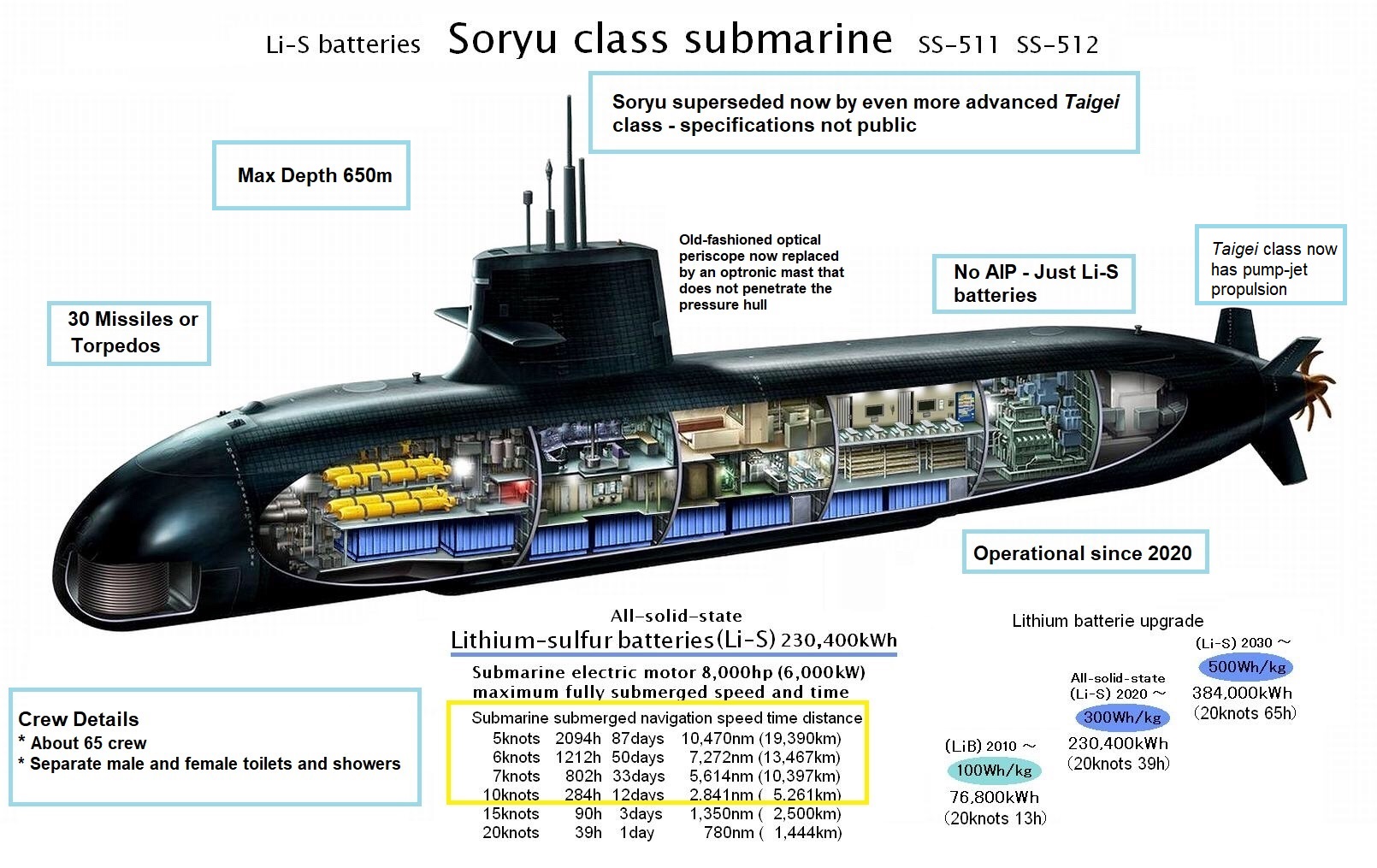
Extended Taigei?
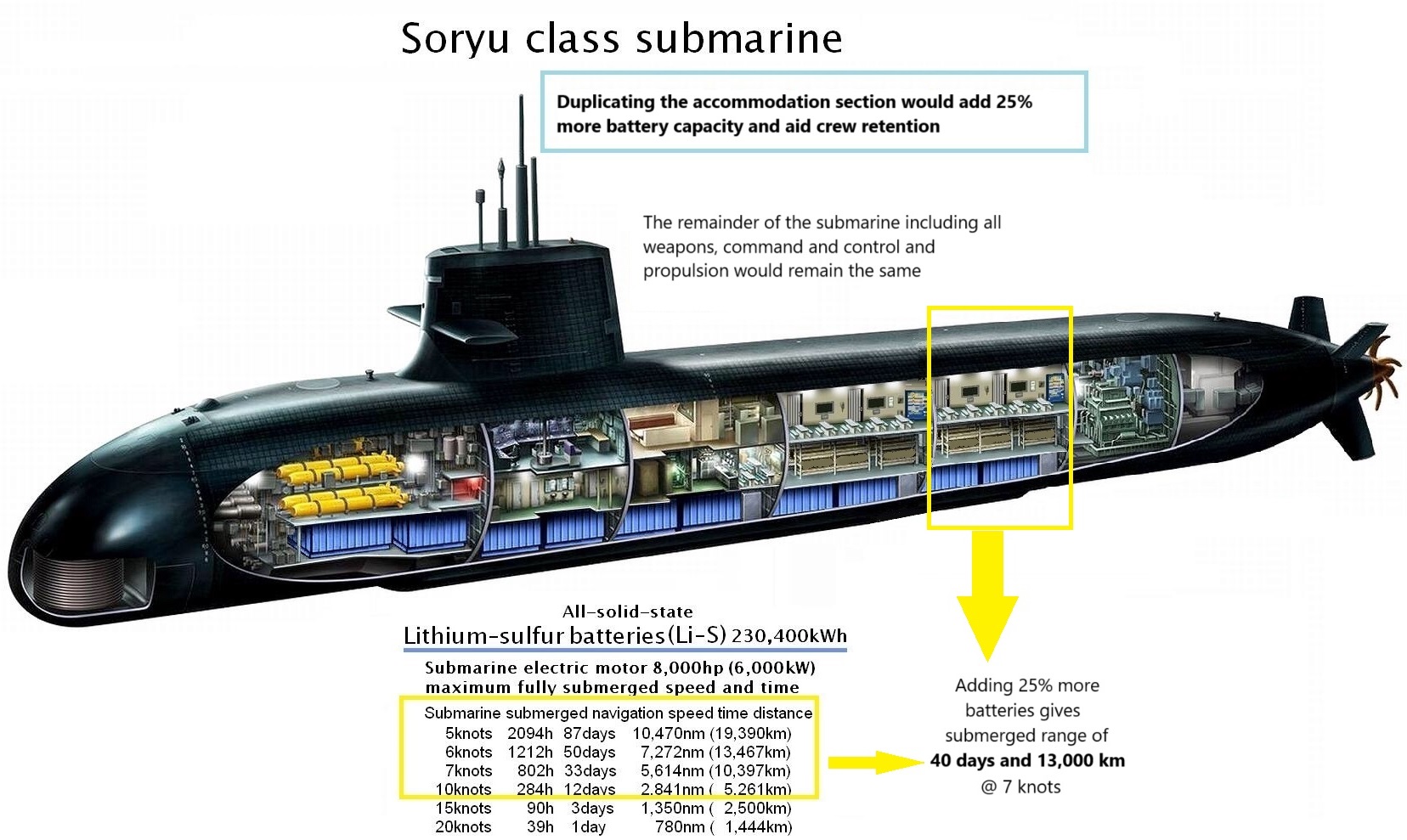
Duplicating the crew accommodation section in the above diagram would seem to increase the battery capacity by 25%. As well as improving morale and crew retention submerged range should be increased to well over a month at minimal cost.
AUKUS submarines
The purpose of the AUKUS submarines is to attack the PRC, which has 600+ nuclear warheads in 2025. We have eight cities.
Note also that if nuclear submarines were ever built superpower adversaries would be obliged to destroy them before they could be launched – which would create a Chernobyl-like problem if they were fuelled at the time.

French nuclear submarines
Peter Briggs, president of the Submarine Institute of Australia, has suggested buying the French Suffren Class nuclear submarines instead of the AUKUS SSN. These would probably be very capable but unfortunately take 15 years to complete compared to 2 years for the Taigei and cost 3 to 4 times as much.