Unfortunately tactical nuclear weapons are needed to deter superpower navies
In a no-rules world nations will be either:
- Nuclear-armed
- Colonies
- Rubble
| Russia | USA & Israel | PRC | India | DPRK |
 |
 | 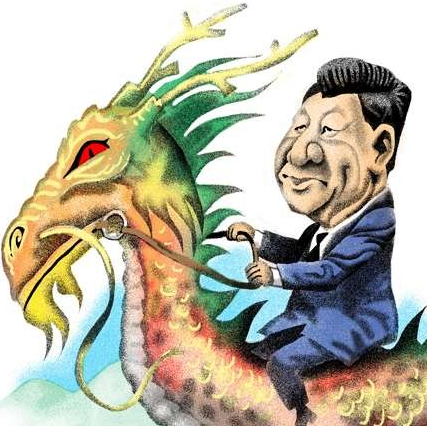 |  | 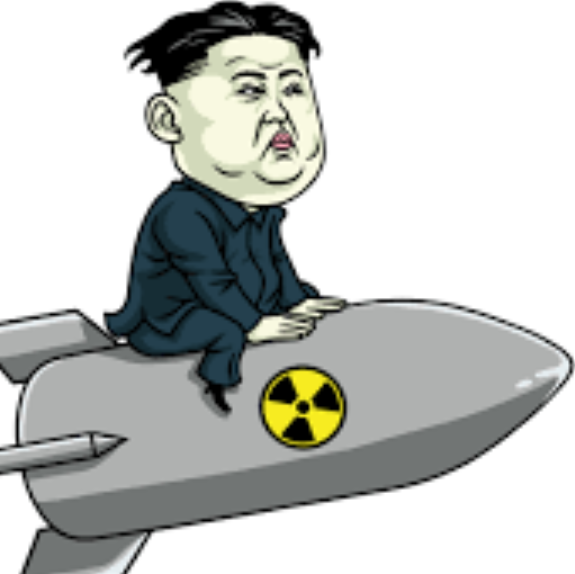 |
 4,400 | 3,790 | 620 | 190 | 60 |
No UN, no international law
In the new world, nukes rule. There is no effective UN and no rules.
- The last treaty between the USA and Russia expired in February 2026.
- The nuclear non-proliferation treaty has failed – signatories are increasing their arsenals, not phasing them out.
- ICAN is futile – no nuclear power will make the same mistake as Ukraine and give up its weapons.
- Large aircraft carriers are virtually impossible to sink with conventional weapons.
Tactical vs. strategic nuclear weapons

| Type | Kilotons* | Notes |
|---|---|---|
| Strategic nuclear weapons | 100 – 10,000 | Obliterates a whole region. Nuclear fallout over huge area. Need ICBM’s / SLBM‘s to deliver them. Millions of dead civilians. NOT RECOMENDED |
| Tactical nuclear weapons | 0.02 to 10 | Destroys a military target. Damage radius ~1km. Can be designed to minimize fallout. Can be delivered by anti-ship missiles. RECOMENDED |
| Fat Man (Nagasaki bomb) | 20 | Destroyed a small city. 80,000 fatalities |
Tactical nuclear weapons
In the Cold War, small nuclear weapons were designed by the USSR to destroy armoured formations but not leave behind harmful levels of radiation on the battlefield.
This would allow forces to push through the destroyed area in the days after the blast to seize territory.
| In Australia’s case the battlefield would be the seas around Australia and the targets would be warships. |
Tactical nuclear weapons can also be used to create Electro Magnetic Pulse effects to blind hosile fleets and hopefully warn them off without killing the crews.
Australian should obtain tactical nuclear weapons for anti-ship missiles.
Nukes = independence
If Australia possessed small tactical nuclear weapons we could retain significant independence as long as we didn’t directly threaten the superpowers.
Because of the small size of tactical nuclear weapons, we should be able to build enough of them to make Australia an unattractive target. Our remoteness also helps – we are not ‘in the way’.
Like France and the UK, we may be able to retain a ‘bubble’ around the country that could encompass New Zealand and some nearby pacific island nations that the superpowers don’t really need.
Obtaining nuclear material
There are several possible sources of sufficient nuclear material to construct small tactical nuclear warheads.
| Source | Rationale |
|---|---|
| UK | We let them do testing here, historical ties, WWII, they play cricket, etc. |
| France | Australia helped France in WWI and II |
| Pakistan | A commonwealth country, they play cricket, they are going bankrupt, etc. (Close PRC ally) |
| India | A commonwealth country, they play cricket, many Indians live here. (Russian ally) |
| Japan, Canada, Brazil, South Korea, Germany & the Netherlands | These countries are said to be “nuclear threshold states” (along with Iran). Given recent developments they are probably scrambling to advance these projects. We may be able to do deals with them in exchange for food, money or minerals. |
| Domestic | Converting uranium ore into weapons grade material is difficult, dangerous, dirty, expensive & time-consuming. Purchasing ready-made fissile material and expertise would be preferable. |
Ideally multiple sources could be used.
Limiting fallout
The plan should be to detonate the device well ABOVE the targeted hostile ship to minimize fireball interaction with the sea surface as that creates fall-out.
See also: Just How Radioactive Are Low-Yield Nuclear Weapons? (The War Zone)
Nuclear weapons legacy in Australia
Note that 12 nuclear weapons have been detonated in Australia in the past with yields of between 1 and 60 kilotons.
Unfortunately some other tests invoved deliberately spreading about 24 kilograms of plutonium-239 with explosives which obviously left a long-lasting legacy. It is likely that these “minor tests” that caused most of the residual contamination.
Delivery

Due to the fact that E=MC2, nuclear warheads are smaller than conventional warheads but with much greater explosive force.
This means regular anti-ship missiles could be adapted to carry small tactical warheads.
Nuclear armed anti-ship missiles could potentially be launched from trucks or aircraft greatly increasing deterrence. Naval vessels and long-range aircraft should never be armed with nuclear weapons as this would seriously threaten our neighbours. ASEAN neighbours would need to be able to verify this.
It is extremely unlikely that such a device would ever need be used.

Nuclear vs. conventional
Conventional weapons need to penetrate the hull of a warship to actually do any serious damage. In the case of an aircraft carrier, dozens of missiles would need to hit the ship to disable it. Given the extensive layers of protection around an aircraft carrier this is practically impossible.
A tactical nuclear warhead could be detonated several kilometers away from a carrier and still disable the vessel.
Deterrence

A US W54 nuclear backpack weapon
In addition to deterring hostile shipping around Australia, tactical nuclear weapons also serve in an unspoken deterrence role as great power leaders know how portable these weapons are.
They want to be able to keep having big rallies and military parades without having to think about a W54 in a backpack somewhere, so would not want to obliterate Australian cities without good cause.
Safety and security

These issues have been solved by the UK, France and other nuclear weapons states.
We should be able to replicate whatever systems the UK has to avoid losing track of where the nukes are.
| Our plan would be to keep these weapons in a disasembled state so that no single weapons repository had more than one nuclear weapon component at any given time – except in times of hightened risk. |
Public support
Australians are becoming increasingly uneasy about the global security situation.
This will increase if Ukraine and Taiwan fall.
Given we would be suggesting some of the world’s smallest nuclear weapons to deter ships, public support would be there.
Note that Australia would need to obtain the weapons and the delivery systems before announcing publicly that we had them.
Nuclear subs, nuclear power … could nuclear weapons be next?
Nuclear power still uneconomic
Note that we do not support nuclear fission power for Australia.
Australia has plenty of wind, sun and wave power that makes expensive nuclear fission power uneconomic as the CSIRO and many others have said.
Nuclear fusion power may be economic in the future, we will have to wait and see.
(It could be that some fission reactors are needed for weapons production. If so they would be deeply buried and not be a source of any significant electricity for the grid.)
Nuclear submarines still not needed
We don’t support nuclear fission submarines either as they are not needed to defend Australia.
We do not support the idea of obtaining forces to attack nuclear superpowers in the northern hemisphere. Obviously they could retaliate massively against us if we did.
Advanced non-nuclear submarines can submerge for a month without snorting and are much cheaper to buy and operate and are quite adequate for defence.
Fusion-powered submarines might be an option in the future.
Other defensive measures
None of the above contradicts what we already suggest for conventional forces here.